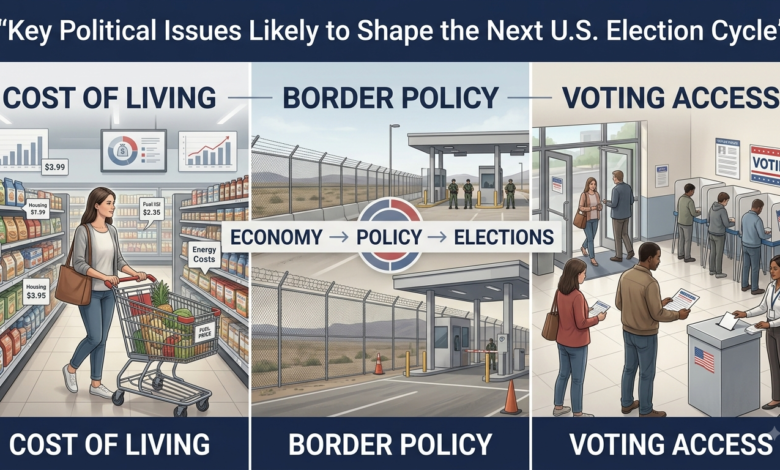
Key-Issue Comparison Table of U.S. Election Issues 2026
| Issue | Why It Matters | Voter Concern | Major Policy Debate | Potential Election Impact |
| Cost of Living & Economy | Direct impact on household budgets and purchasing power | High (48% top priority in recent August 2026 Reuters/Ipsos polling) | Tariff impacts, Fed interest rates, corporate taxation vs. deregulation | Primary driver of congressional generic ballot swings and incumbent vulnerability |
| Immigration & Border Policy | Core element of national security, sovereignty, and local social services | Moderate to High | Federal enforcement tactics, ICE authority, asylum rules, and citizenship checks | Key turnout driver for conservative base; moderate/swing voter backlash on overreach |
| Healthcare & Drug Costs | Covers baseline living expenses, insurance access, and public welfare | Moderate | Prescription price caps, ACA subsidies, government vs. market solutions | Critical issue among suburban voters, independents, and older demographics |
| Abortion & Reproductive Policy | Defines bodily autonomy, state powers, and healthcare access | Moderate | Federal protections vs. state-level restrictions and ballot measures | Mobilizes progressive and suburban women voters in competitive districts |
| Voting Access & Election Rules | Shapes turnout dynamics, democratic legitimacy, and balloting procedures | Moderate | Citizenship verification, mail-in voter ID requirements vs. expanding access | Influences baseline voter participation, turnout ease, and legal post-election disputes |
| Foreign Policy & Defense | Impacts global stability, defense spending, and domestic energy prices | Moderate | U.S. involvement in Middle East conflicts, foreign aid levels, and NATO obligations | Affects consumer energy prices and shapes perceptions of executive leadership |
As the United States approaches the 2026 congressional midterm elections on November 3, 2026, the national political landscape is shaped by a complex interplay of economic pressures, shifting social debates, and emerging technological challenges. All 435 seats in the U.S. House of Representatives and 33 U.S. Senate seats are up for election, alongside dozens of state governorships and legislative chambers.
While the 2028 U.S. presidential election (scheduled for November 7, 2028) remains two years away, the issues debated during this midterm cycle will establish the policy arguments, candidate platforms, and voter coalition alignments for the next presidential contest. This article provides an evidence-based, nonpartisan examination of the primary U.S. election issues in 2026, drawing from government statistics, reputable nonpartisan polling, and legislative actions.
What Issues Will Shape the 2026 U.S. Midterms?
The 2026 midterm election cycle is defined by a mix of immediate economic anxieties and long-standing structural disagreements over the role of government. Rather than a single issue dominating the narrative, several interconnected policy areas shape candidate strategies across the country:
-
Cost of Living and Inflation Dynamics: Household expenditures on food, shelter, energy, and everyday services remain the dominant driver of voter anxiety.
-
Immigration Enforcement and Border Security: Debates over border control, federal agency authorities, and state-federal cooperation continue to divide the electorate.
-
Healthcare Costs and Social Safety Nets: Lowering prescription drug prices, maintaining ACA provisions, and managing entitlement spending remain central policy battlegrounds.
-
Reproductive Rights and State Ballot Measures: State-level court rulings and legislative measures keep abortion access high on the priority list for millions of voters.
-
Election Integrity and Voting Rules: Ongoing legislation regarding voter identification, citizenship checks, and mail-in voting rules affects how elections are administered.
What Issues Matter Most to Voters?
Recent polling provides insight into national voter priorities ahead of the November 2026 midterms.
FACT: According to a Reuters/Ipsos poll fielded July 29–August 3, 2026 (nationally representative probability sample of 4,505 adults aged 18+; margin of error ±1.8 percentage points), 48% of Americans identified the cost of living as their most important factor in deciding how to vote in the 2026 midterm elections.
Cost of Living Priority Shift (2026)
------------------------------------
January 2026: ██████████████████ 39%
August 2026:  ████████████████████████ 48%
POLLING BREAKDOWN (Key Demographics & Party Preferences):
-
By Party: The Reuters/Ipsos August 2026 survey found that 35% of respondents preferred the Democratic Party’s approach to handling the cost of living, compared to 27% preferring the Republican Party. Among self-identified liberals, 71% rated increasing taxes on corporations and billionaires as essential to their political identity, while 67% cited government healthcare for all. For self-identified conservatives, reducing the size of the federal government (46%), reducing foreign aid (40%), and allowing fewer immigrants (43%) ranked as top priorities.
-
By Demographic Group: Sub-segmentation across national polls (including Harvard CAPS/Harris and Ipsos) reveals that lower-to-middle-income suburban voters highlight housing and gas prices as their main pain points. Younger voters (ages 18–29) consistently place higher emphasis on housing affordability, student debt, and social issues, whereas older voters (65+) prioritize Medicare stability, Social Security preservation, and general inflation.
ANALYSIS: While economic concern is widespread across all demographics, party bases diverge sharply on policy solutions. Conservatives favor supply-side deregulation, tax cuts, and spending reductions, whereas progressives advocate for corporate tax adjustments, price caps on essential goods, and expanded safety net benefits.
Regional and Swing-State Differences
Electoral outcomes in 2026 will be heavily influenced by localized economic realities and state-level policy dynamics rather than broad national trends alone.
-
Sun Belt States (e.g., Arizona, Georgia, Nevada): Rapid population growth has heightened debates over housing availability, water rights, and local infrastructure strain. Border policy and immigration enforcement remain significant mobilization tools in Arizona.
-
Rust Belt States (e.g., Pennsylvania, Michigan, Wisconsin): Industrial policy, domestic manufacturing incentives, trade tariffs, and energy transition costs drive voter discussions in these competitive districts.
-
Agricultural and Energy States: Fluctuations in global grain prices, energy export markets, and federal agricultural subsidies heavily influence rural turnout and candidate messaging across midwestern regions.
How Democrats and Republicans May Frame These Issues
Party Framing Overview
-------------------------------------------------------------------------
Democratic Platform Focus  │  Republican Platform Focus
• Cost-of-living relief    │  • Deregulation & spending cuts
• Corporate accountability  │  • Border enforcement & security
• Reproductive rights      │  • Domestic energy production
-------------------------------------------------------------------------
1. Economy and Cost of Living
-
Democratic position/arguments: Emphasize capping prescription drug prices, curbing corporate “price gouging,” expanding child tax credits, and increasing taxes on ultra-wealthy individuals to fund safety-net relief.
-
Republican position/arguments: Attribute price inflation to federal spending, call for significant cuts to non-defense budgets, extend tax reductions, and promote domestic oil and gas production to lower energy costs.
2. Immigration and Border Security
-
Democratic position/arguments: Focus on comprehensive immigration reform, expanding legal pathways for work visas, protecting asylum seekers, and establishing strict oversight and accountability for federal enforcement agencies like ICE.
-
Republican position/arguments: Prioritize strict physical border security, enhanced funding for immigration law enforcement, mandatory citizenship verification, and increased deportation of unauthorized residents.
3. Healthcare and Social Policy
-
Democratic position/arguments: Protect and expand the Affordable Care Act (ACA), codify federal reproductive rights, and lower out-of-pocket medical expenses through federal drug price negotiations.
-
Republican position/arguments: Advocate for free-market healthcare competition, greater state flexibility in administering Medicaid, and moral protections regarding federal healthcare funding.
How the 2026 Midterms Could Shape the 2028 Election Cycle
The outcome of the 2026 midterm elections will directly affect the political environment leading into the November 7, 2028 presidential election:
-
Congressional Power and Agenda Control: If the opposition party gains control of either the House or Senate, it can utilize subpoena power, block judicial appointments, and stall executive legislative priorities.
-
Candidate Platform Testing: Potential 2028 presidential contenders will monitor which message models—such as populist trade policies, progressive economic reforms, or strict fiscal conservatism—resonate best with suburban and independent voters in 2026.
-
Fundraising Coalitions: Midterm performance influences donor confidence and structural campaign infrastructure for national party organizations entering the 2028 cycle.
SCENARIO: A divided federal government resulting from the 2026 midterms could lead to legislative gridlock, forcing major policy debates—such as tax reform, trade rules, and entitlement spending—onto the 2028 presidential campaign trail.
Why Interest Rates Could Become a Political Issue
The monetary policy set by the Federal Reserve carries direct political ramifications ahead of the 2026 elections.
FACT: In July 2026, the Federal Reserve maintained its target benchmark federal funds rate at 3.50%–3.75%, balancing inflation mitigation against labor market stability. Concurrently, U.S. Consumer Price Index (CPI) data from the Bureau of Labor Statistics showed annual inflation slowing to 3.4% in July 2026.
Key Economic Indicators (July/August 2026)
------------------------------------------
• Federal Funds Rate: 3.50% – 3.75%
• Annual CPI Inflation: 3.4%
• Consumer Sentiment Index: 49.4 (LSEG/Ipsos)
-
Housing Affordability: Higher borrowing rates keep mortgage rates elevated, reducing housing affordability for first-time buyers and becoming a central economic complaint for younger families.
-
Consumer Credit: Elevated interest rates on credit cards and automobile loans increase monthly household costs, impacting consumer confidence indices (e.g., LSEG/Ipsos Primary Consumer Sentiment Index reading of 49.4 in August 2026).
ANALYSIS: While the Federal Reserve acts independently of elected officials, both political parties routinely incorporate central bank decisions into their political narratives—incumbents point to stabilizing inflation rates, while challengers highlight high borrowing costs for working families.
The Role of Immigration, Healthcare and Social Policy
Beyond overall economic statistics, social and enforcement policy remain critical voter drivers:
-
Immigration Enforcement Operations: Polling indicates nuanced public sentiment. While a strong majority of voters support the deportation of non-citizens convicted of violent crimes, majorities also express concern over enforcement tactics, with a January 2026 Harvard CAPS/Harris poll recording 57% of voters indicating that ICE and Border Patrol enforcement tactics had gone too far in urban areas.
-
Prescription Drug Pricing: Bipartisan support exists for efforts to lower out-of-pocket costs for critical pharmaceuticals, making drug cost reduction proposals prominent in swing-district advertising.
-
State Ballot Initiatives: In several states, non-partisan ballot measures concerning abortion access, minimum wage increases, and ranked-choice voting will run alongside congressional races, impacting base voter turnout.
Foreign Policy, Trade and National Security
International developments directly affect domestic economic stability and national security debates:
-
Middle East and Global Energy Prices: Geopolitical friction in the Middle East—such as ongoing conflicts involving Iran—has created volatility in global oil markets. Fluctuations in domestic gas prices directly influence voter perceptions of national economic stability.
-
Tariffs and Industrial Policy: Disagreements persist over trade tariffs. Supporters argue tariffs protect domestic manufacturing and secure vital supply chains; critics contend that import duties act as a tax on domestic consumers, elevating prices on manufactured goods.
-
Defense Spending vs. Domestic Priorities: Competing arguments focus on the balance between national defense expenditures, international aid commitments, and domestic entitlement spending.
AI, Misinformation and Technology
Rapid developments in artificial intelligence present new operational and regulatory challenges for the 2026 election cycle:
-
AI-Generated Political Content: The widespread availability of generative audio and video tools has raised concerns regarding synthetic media (“deepfakes”) designed to mislead voters shortly before elections.
-
Platform Content Policies: Major technology platforms face scrutiny from both sides of the aisle—conservatives often allege bias in content moderation, while progressives argue platforms fail to curb deliberate election misinformation.
-
Regulatory Debates: Federal and state lawmakers are debating legislation regarding watermarking synthetic media, protecting user data privacy, and managing AI’s impact on employment.
Five Developments That Could Quickly Reshape the Election
Political campaigns operate in a dynamic environment where unexpected events can rapidly alter voter focus.
-
A Sudden Energy Shock: Spikes in global crude oil prices due to foreign conflicts could abruptly push domestic gasoline prices higher, intensifying consumer concern over general inflation.
-
Federal Reserve Policy Shifts: Unanticipated changes in interest rate strategy—either sharp cuts or surprise hikes—would significantly adjust housing market dynamics and consumer sentiment.
-
Major Federal Court Rulings: High-court decisions regarding administrative agency powers, state voting laws, or executive actions can quickly re-energize party bases.
-
Unexpected Employment Market Changes: Significant shifts in national unemployment figures would reframe debates over economic management.
-
Major Foreign Policy Escalations: Unforeseen international crises could force national security and defense preparedness to the top of campaign agendas.
The Five Issues Most Likely to Dominate Headlines
Based on multi-poll aggregation, media attention, and policy debate, these five issues are positioned to dominate campaign headlines leading up to November 3, 2026:
-
Cost of Living & Core Inflation: Everyday expenses remain the top issue for voters across political spectrums.
-
Border Enforcement & Immigration Law: Sharp debates over law enforcement procedures, state vs. federal jurisdiction, and legal status.
-
Interest Rates & Housing Costs: The direct effect of Federal Reserve benchmark rates on homeownership and credit card debt.
-
Healthcare Affordability: Public debates surrounding ACA protections, Medicare funding, and prescription drug caps.
-
Voting Administration & Access Rules: Legal challenges and political battles over state-level voter registration requirements and mail-in balloting procedures.
Which Issues Could Carry Into 2028?
Certain structural issues are likely to persist as focal points for the 2028 U.S. presidential election cycle:
-
Persistent Structural Issues: Long-term federal debt levels, national housing supply shortages, healthcare entitlement funding, and geopolitical competition with global rivals will remain central long-term policy challenges.
-
Issues That May Shift: Specific legislative debates or immediate gas price fluctuations may fade or transform depending on macroeconomic developments and intermediate policy resolutions over the next two years.
FAQ
What issues will shape the 2026 U.S. midterms?
The primary issues shaping the 2026 midterms include the cost of living and inflation, immigration and border policy, healthcare costs, interest rates, voting access laws, and foreign policy developments.
What are the biggest concerns for U.S. voters in 2026?
According to recent August 2026 polling by Reuters/Ipsos, the cost of living is the top concern for voters, with 48% identifying it as their primary decision-making factor. Immigration, healthcare, and overall economic performance also rank high among voter concerns.
Will the economy be the biggest election issue?
While economic conditions—particularly prices, housing, and wages—are central to voter sentiment, turnout and final election outcomes will also depend on candidate quality, state-level issues, and mobilization around social policy.
How important is immigration in the 2026 elections?
Immigration remains a major mobilization issue for both parties. Conservatives emphasize border security and strict enforcement, while progressives and independents focus on humanitarian protections, legal pathways, and agency oversight.
Could abortion affect the midterms?
Yes. State-level ballot initiatives, judicial rulings, and state legislative proposals regarding reproductive healthcare continue to drive voter engagement, particularly among suburban women and progressive bases.
How could foreign policy influence U.S. elections?
International events in regions such as the Middle East influence domestic elections directly when they impact global oil markets and fuel prices, and indirectly by shaping public debates over defense spending and international commitments.
What issues could carry into the 2028 presidential election?
Structural issues such as federal debt management, tax policy, long-term housing access, trade tariffs, and entitlement program stability are expected to carry forward into the 2028 presidential campaign.
When is the next U.S. presidential election?
The next U.S. presidential election is scheduled to take place on November 7, 2028, following the November 3, 2026 congressional midterm elections.
The 2026 U.S. midterm elections represent a critical juncture in American politics. While household economic concerns—specifically inflation, interest rates, and overall living expenses—lead public priority lists, the political landscape is simultaneously defined by debates over border enforcement, healthcare affordability, voting access, and global stability. As campaigns intensify ahead of November 3, 2026, how candidates address these core policy areas will determine congressional control and set the trajectory for the 2028 presidential cycle.