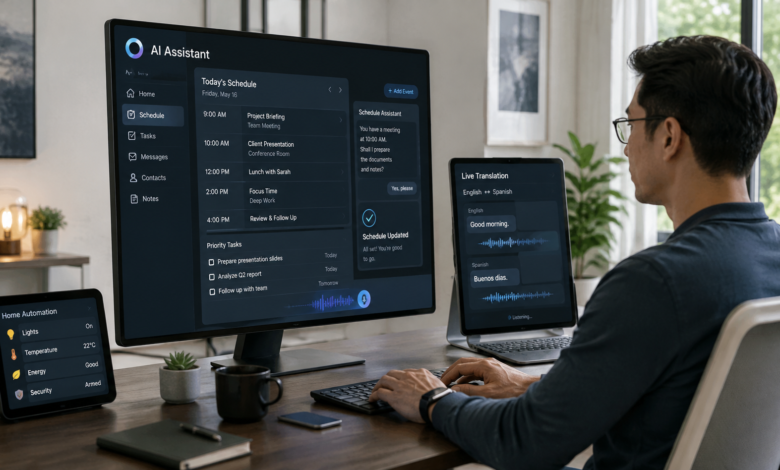
AI Innovation Comparison Table
| AI Innovation | Current Status | Likely Everyday Impact by 2031 | Main Barrier |
| AI Agents | Emerging | High | Reliability & non-deterministic error rates |
| On-Device AI | Growing | High | Hardware, thermal, and battery constraints |
| Multimodal AI | Available / Emerging | High | Accuracy, edge-case context, and hallucinations |
| AI Robotics | Emerging | Medium–High | Unit cost, safety certification, and physical-world complexity |
| AI Translation | Available / Emerging | High | Contextual/cultural nuance and real-time audio latency |
| Healthcare Decision Support | Emerging | High | Regulatory approval, clinical liability, and data silos |
| AI-Generated Search | Available / Emerging | High | Source verification, publisher economics, and hallucination risks |
| Smart Home Coordination | Emerging | Medium | Interoperability standards (Matter/Thread) and data privacy |
As of August 2026, artificial intelligence has transitioned from conversational chatbots into embedded systems operating across consumer hardware, software platforms, and industrial infrastructure. Generative tools that were novel years ago are now standard features in operating systems, search engines, and workplace suites. However, the central question for consumers and enterprise leaders remains: Which AI innovations possess a credible path from current capabilities to meaningful, reliable everyday use between 2026 and 2031?
Predicting technology adoption requires separating research breakthroughs from commercially viable, broadly adopted consumer tools. While public attention often focuses on hypothetical artificial general intelligence (AGI) or fully autonomous humanoids, the most transformative five-year shifts are driven by practical refinements: specialized autonomous software agents, local on-device hardware acceleration, real-time multimodal translation, and AI-assisted clinical and educational workflows.
This analysis evaluates the technical maturity, operational barriers, and realistic adoption trajectories of the key AI innovations shaping daily routines over the next five years.
What Could AI Look Like by 2031?
Forecasting technology across a five-year horizon requires distinguishing between three distinct phases of maturity:
-
Technologically Possible: Capabilities demonstrated in research labs or controlled benchmarks (e.g., zero-shot robotic task completion or advanced multi-step reasoning models).
-
Commercially Viable: Scalable products that function within economical compute budgets, clear regulatory frameworks, and acceptable error margins.
-
Widely Adopted: Consumer and enterprise software integrated into daily habits, supported by robust hardware and user trust.
By 2031, AI is unlikely to replace basic human decision-making or restructure society overnight. Instead, the technology is expected to shift from a reactive interface—where users explicitly prompt a system for answers—to an ambient, agentic layer. In this environment, software executes background tasks, coordinates cross-application workflows, and adapts dynamically to context, while human oversight remains critical for high-stakes decisions.
AI Innovations Expected to Transform Everyday Life
1. AI Agents
-
Evolution: Software has evolved from simple text-matching chatbots to natural language assistants, and is currently moving toward agentic architectures. Modern AI agents use foundation models to break down high-level user instructions into sub-tasks, select software tools, call APIs, and execute multi-step workflows autonomously.
-
Capabilities: In everyday contexts, agentic systems could handle flight rebookings, negotiate appointments across multiple schedules, synthesize multi-source research into formatted briefs, and run routine back-office enterprise workflows.
-
Current Status & Challenges: Enterprise deployment of specialized agents is accelerating, with Gartner projecting that 40% of enterprise applications will embed task-specific agents by late 2026. However, non-deterministic error rates, “agentic loops,” security risks like prompt injection, and unclear liability frameworks prevent full autonomy in unregulated consumer or financial settings.
2. AI Personal Assistants
-
Capabilities: Next-generation personal assistants are shifting toward continuous, cross-application context awareness. Utilizing persistent memory, multimodal inputs, and local screen-reading models, future assistants could track long-term personal projects, proactively suggest task follow-ups, and manage administrative errands without requiring detailed manual prompts.
-
Privacy Trade-Offs: Proactive, deeply personalized assistance requires extensive data access—including calendars, emails, location history, and real-time screen activity. Balancing context quality with strict local encryption and user permission models remains a core technical and regulatory challenge.
3. Multimodal AI
-
Capabilities: Multimodal foundation models process text, audio, images, video, and sensory data natively within a single architecture. Current systems allow users to point a smartphone camera at an object or document, speak naturally, and receive context-aware explanations or real-time troubleshooting assistance.
-
Everyday Applications: Applications span real-time visual assistance for visually impaired users, adaptive visual tutoring in education, hands-free field service guidance, and automated video synthesis for content creators.
4. On-Device AI
-
Capabilities: On-device AI routes inferences directly to local Neural Processing Units (NPUs) on smartphones, PCs, wearables, and automobiles rather than relying entirely on cloud servers.
-
Benefits & Limitations: Local processing significantly lowers latency, enables offline execution, protects user privacy by keeping data on the device, and reduces data center energy consumption. However, devices face hardware constraints: memory bandwidth, battery power, and thermal limits cap the size and complexity of locally hosted models.
5. AI PCs and AI Smartphones
-
Capabilities: Modern consumer hardware increasingly features dedicated NPUs capable of driving 10 to 45 TOPS (Trillions of Operations Per Second). This hardware powers local system tasks such as live voice transcription, real-time image upscaling, predictive text generation, local file semantic search, and zero-latency audio noise suppression.
-
Market Outlook: While hardware availability is growing rapidly, software developer ecosystems are still catching up. An NPU alone does not deliver direct consumer value without optimized application software that leverages local silicon effectively.
6. AI in Healthcare
-
Capabilities: Credible applications focus on clinical decision support, medical imaging triage, administrative paperwork reduction, accelerated early-stage drug discovery, and continuous remote patient monitoring.
-
Regulatory & Safety Boundary: Medical AI systems operate primarily as diagnostic aids for clinicians rather than autonomous diagnostic tools. Regulatory bodies such as the U.S. FDA and the World Health Organization (WHO) emphasize rigorous clinical validation, clear human-in-the-loop requirements, and auditability to prevent diagnostic errors and bias.
7. AI-Powered Education
-
Capabilities: AI systems enable adaptive learning platforms that tailor exercise difficulty, explanation styles, and feedback to individual student pace. Teachers leverage AI tools for automated administrative work, personalized lesson plans, and multi-language support.
-
Risks & Ethical Concerns: Widespread adoption faces challenges around academic integrity, student data privacy, equitable access across underfunded school districts, and the risk of over-relying on automated tutoring over human pedagogy.
8. AI and Robotics
-
Capabilities: Advances in vision-language-action (VLA) models allow physical robots to translate natural language commands into motor actions. Industrial and warehouse robotics are increasingly flexible, while humanoid and home service robots remain in active development.
-
Physical-World Complexity: Software operates in controlled digital environments, whereas physical robots must navigate unstructured, unpredictable real-world spaces with strict safety margins. High component costs, battery limitations, and physical safety certification make widespread home robotics a longer-term transition compared to enterprise automation.
9. AI in Transportation
-
Capabilities: AI powers Advanced Driver Assistance Systems (ADAS)—including automated lane centering, adaptive cruise control, and automated parking—alongside logistics route optimization, predictive maintenance, and localized delivery drones/bots.
-
Autonomous Realities: Level 2 and Level 3 assisted driving are widely available in production vehicles. However, unconstrained Level 5 fully autonomous driving across all weather conditions and geographies remains technologically unproven for universal deployment by 2031, with commercial robotaxis operating primarily in mapped, geofenced urban corridors.
10. Real-Time Translation
-
Capabilities: Neural translation models now support low-latency speech-to-speech translation, maintaining speaker pitch and cadence while generating live subtitles or audio overlays.
-
Impact: Low-cost, real-time translation reduces language barriers across global business, international education, tourism, and cross-cultural media consumption, though idiomatic and localized context nuances still require model refinement.
11. AI-Generated Search and Information
-
Capabilities: Traditional link-based search engines are increasingly augmented or replaced by generative answer engines that synthesize multi-source information into direct conversational summaries.
-
Risks: The widespread transition to answer engines introduces challenges around hallucinated information, source attribution, search engine optimization (SEO) manipulation, and the financial sustainability of web publishers facing reduced referral traffic.
12. AI-Powered Smart Homes
-
Capabilities: AI is improving home automation by shifting from rigid, manually programmed routines to context-aware ambient systems that adjust lighting, HVAC, energy storage, and security appliances based on occupant habits and real-time electricity pricing.
-
Barriers: Adoption is hindered by fragmented device standards, setup complexity, and consumer reluctance to place connected sensors and micro-phones throughout private living spaces.
13. AI Cybersecurity
-
Capabilities: Enterprise defenses use machine learning models for real-time anomaly detection, automated incident response, predictive vulnerability management, and sophisticated phishing email identification.
-
Asymmetric Threats: Concurrently, malicious actors leverage generative tools to automate personalized spear-phishing attacks, discover software zero-day vulnerabilities, and generate deepfake voice or video media for social engineering fraud.
14. AI in Finance
-
Capabilities: Financial institutions deploy machine learning for real-time credit card fraud detection, algorithmic risk modeling, automated back-office document processing, and consumer personal budgeting tools.
-
Constraints: High regulation, algorithmic auditing requirements, and strict anti-discrimination laws mean automated systems in banking function primarily as risk-scoring mechanisms with human compliance oversight.
15. AI Accessibility
-
Capabilities: Multimodal AI provides powerful tools for individuals with disabilities, including real-time visual scene descriptions for visually impaired users, automated live captioning and sign-language interpretation, and speech-synthesis tools tailored for individuals with speech impairments.
-
Practical Focus: These tools enhance independence in education, workplaces, and daily navigation, focusing on practical functional assistance.
A Day in the Life With AI in 2031
Note: The following scenario illustrates how commercially viable technologies could function together in a hypothetical daily routine.
-
Morning: An on-device assistant analyzes overnight schedule changes, weather conditions, and commute traffic, presenting a consolidated morning brief. It automatically reschedules a low-priority morning check-in to clear time for an urgent project deliverable.
-
Work: During a project meeting, an ambient assistant transcribes discussion points in real time, generates structured action items, and routes software ticket updates directly to the engineering team’s project board. An agentic research tool drafts an initial competitive intelligence summary by cross-referencing internal files with external industry reports.
-
Afternoon: While studying a complex technical topic, an educational tool breaks down dense research into customized visual diagrams and interactive step-by-step walk-throughs. Later, a multimodal shopping assistant compares replacement hardware components based on photos of damaged parts, checking local store inventory for same-day delivery.
-
Evening: The home energy management system adjusts home cooling and charges an electric vehicle based on dynamic off-peak utility tariffs. At dinner, a personal assistant coordinates a multi-family weekend trip by identifying open calendar slots across eight participants and drafting proposed itineraries.
Will AI Replace Jobs or Change Them?
The economic impact of AI centers primarily on task automation and task augmentation, rather than the wholesale elimination of entire occupations.
-
Task-Level Automation: Jobs consist of multiple distinct tasks. AI excels at automating repetitive data entry, basic code generation, initial draft writing, schedule coordination, and primary document review.
-
Augmentation and Productivity: By shifting routine administrative burdens to automated software, workers in fields such as healthcare, software engineering, law, and customer support can reallocate time toward high-level strategy, complex problem-solving, and direct client care.
-
Economic Adjustment: While productivity may rise, transition friction remains real. Entry-level roles heavy on routine execution face changing hiring patterns, creating demand for workforce reskilling programs focused on AI tool fluency, critical evaluation, and domain expertise.
The Privacy Trade-Off
The functionality of personalized AI relies directly on context:
This creates a fundamental privacy trade-off:
-
High Context, High Utility: Granting AI access to personal communications, medical records, financial transactions, and real-time location data produces highly capable, proactive assistance.
-
Data Security & Privacy Risks: Storing personal context—whether on cloud infrastructure or local storage—increases exposure to data breaches, unauthorized corporate tracking, and potential regulatory non-compliance. Local, zero-knowledge on-device processing and granular privacy permission controls are critical prerequisites for consumer trust.
Why Reliability Could Determine AI Adoption
The primary bottleneck to mainstream AI agent deployment is non-deterministic behavior and reliability.
-
The Hallucination Challenge: While probabilistic language models produce highly fluent text, they occasionally generate incorrect facts, flawed code, or inaccurate references with high confidence.
-
High-Stakes vs. Low-Stakes Use: A 90% accuracy rate may be acceptable for brainstorming creative marketing headlines, but it is unusable for clinical diagnostics, automated legal contracts, or autonomous financial transfers.
-
Verification Costs: If checking an AI agent’s work takes longer than performing the task manually, the net productivity gain vanishes. Widespread adoption in high-stakes domains requires robust verification layers, strict guardrails, and deterministic testing frameworks.
How Regulation Could Shape AI’s Future
Regulatory frameworks worldwide are transitioning from theoretical guidelines to active enforcement:
-
European Union (EU AI Act): Full enforcement mechanisms for high-risk AI categories (Annex III) and general-purpose AI transparency obligations take effect throughout 2026. The law mandates strict conformity assessments, risk management protocols, fundamental rights impact assessments, and heavy fines for non-compliance.
-
United States: Regulatory approaches focus on agency-specific guidance, safety standards via the National Institute of Standards and Technology (NIST) AI Risk Management Framework, critical infrastructure guidance, and state-level data privacy legislation.
-
Global Impact: Compliance costs, mandatory algorithmic audits, transparency rules, and copyright liability dictate how rapidly tech companies can launch autonomous consumer features.
The Infrastructure Behind the AI Boom
Deploying global AI capabilities requires massive physical infrastructure:
-
Compute and Hardware: Model training and inference rely on high-density data centers packed with specialized AI accelerators, creating supply chain dependencies around advanced semiconductor manufacturing.
-
Energy and Grid Capacity: AI workloads consume substantial electrical power. Scaling AI features across billions of daily query inputs requires substantial energy grid expansions, increased renewable energy generation, advanced liquid cooling technology, and optimized model efficiency to prevent grid strain.
Will AI Become Cheaper and More Accessible?
Model inference costs have dropped significantly over recent years due to architectural optimizations, smaller domain-specific models, specialized NPU hardware, and competition from open-source foundation models.
-
Model Distillation & Quantization: Highly capable 7-billion to 14-billion parameter models can now run locally on consumer-grade smartphones and laptops, executing tasks that previously required cloud supercomputers.
-
Democratization: Lower inference costs make AI tools accessible to small businesses, educational institutions, and developing markets, shifting the technology from an expensive enterprise capability to an accessible utility.
Will Everyone Experience the AI Revolution at the Same Speed?
AI adoption rates vary significantly across regions and demographics due to structural factors:
-
Infrastructure Gaps: High-speed internet access, reliable power grids, and modern NPU-equipped consumer hardware are unevenly distributed globally.
-
Language Representation: English and high-resource languages feature superior model training data and accuracy compared to low-resource regional languages.
-
Economic Factors: High enterprise adoption in regions like North America reflects infrastructure readiness, enterprise software spending power, and localized cloud availability.
Five AI Innovations Most Likely to Change Everyday Life by 2031
-
Embedded Multimodal Assistants: Natural voice-and-vision interactions replacing traditional UI menus across smartphones, wearables, and operating systems.
-
On-Device Local AI: Fast, private, offline-capable models handling transcription, search, and personal productivity natively on consumer devices.
-
Specialized Task-Oriented AI Agents: Automated background workflow engines managing routine software admin, booking, and workplace tasks.
-
AI-Enhanced Clinical Workflow & Imaging: Automated medical documentation and diagnostic decision support reducing administrative burn-out for doctors.
-
Real-Time Speech-to-Speech Translation: Frictionless cross-language audio communication embedded directly into web browsers, video calls, and mobile apps.
What Could Prevent These AI Innovations From Going Mainstream?
-
Reliability Deficits: Persistent hallucinations and unpredictable non-deterministic edge cases in critical applications.
-
Infrastructure Constraints: High energy costs, data center power caps, and semiconductor supply bottlenecks.
-
Privacy & Security Vulnerabilities: Cyber threats like prompt injection, data poisoning, and unauthorized personal data exposure.
-
Regulatory Compliance Friction: Complex, varying international legal requirements delaying commercial deployments.
-
Lack of Interoperability: Software silos preventing AI agents from communicating seamlessly across competing ecosystems.
AI in 2031: Three Possible Futures
Scenario A: Conservative (Assistant-Focused)
AI capabilities plateau around basic administrative tasks. Models remain highly capable search and drafting assistants, but persistent reliability and safety challenges restrict autonomous agents from taking unmonitored real-world actions.
Scenario B: Mainstream (Agentic & Multimodal Integration)
AI agents and multimodal systems become standard software features. On-device processing handles daily personal productivity privately, while cloud-based specialized agents reliably manage structured enterprise workflows under light human supervision.
Scenario C: Accelerated (Deeply Integrated Autonomous Systems)
Rapid hardware and algorithmic breakthroughs solve core reliability issues. Autonomous agents, adaptive robotics, and ambient smart-home environments operate continuously in the background, significantly restructuring daily workflows, logistics, and service industries.
Which Future AI Trends Are Already Here?
-
Already Mainstream: Generative writing aids, cloud-based code completion, live voice transcription, automated search answer engines, and basic consumer image creation.
-
Early Adoption / Scaling: Task-specific enterprise AI agents, NPU hardware in consumer laptops/phones, multimodal natural language voice assistants, and medical diagnostic assistance tools.
-
Still Experimental / Restricted: Fully autonomous Level 5 self-driving, general-purpose household humanoid robotics, unmonitored autonomous agentic purchasing, and autonomous medical diagnosis.
FAQ
What AI innovations could change everyday life by 2031?
The most impactful innovations include multimodal voice-and-vision assistants, task-specific software agents, local on-device AI processing, real-time translation, and clinical documentation assistance in healthcare.
Will AI agents become mainstream?
Task-specific AI agents are rapidly entering enterprise environments for structured workflows. Broad mainstream consumer adoption depends on solving key reliability, hallucination, and privacy challenges over the next five years.
How will AI affect jobs?
AI primarily automates specific routine tasks within occupations rather than eliminating whole jobs. This shifts worker focus toward higher-level analysis, strategy, and interpersonal communication while driving demand for reskilling.
Will AI become more common on smartphones and PCs?
Yes. Dedicated Neural Processing Units (NPUs) are now standard hardware in new laptops and smartphones, enabling faster, private, offline-capable AI features directly on the device.
How could AI change healthcare?
AI assists clinicians by reducing administrative paperwork burdens, triaging medical imaging, predicting health risks, and speeding up drug discovery, operating as a decision-support aid rather than an autonomous physician.
Will robots become common in homes?
While specialized single-purpose robots (like robotic vacuums) remain popular, general-purpose humanoid or home service robots remain largely in development due to high hardware costs, energy constraints, and safety challenges.
How will AI affect education?
AI supports personalized tutoring, adaptive practice problems, automated grading for teachers, and language translation, though challenges around academic integrity and equitable access remain key concerns.
What are the biggest barriers to AI adoption?
The primary limits include model hallucination risks, energy and compute infrastructure bottlenecks, strict data privacy regulations, high enterprise integration costs, and user trust.
The trajectory of AI between 2026 and 2031 is defined by a shift from novel conversational interfaces to reliable, embedded infrastructure. While science-fiction depictions of total automation remain far from daily reality, practical innovations—such as on-device processing, multimodal interaction, real-time translation, and specialized workflow agents—are set to reshape how people work, learn, communicate, and manage daily life. Navigating this transition successfully requires balancing technological adoption with ongoing investments in reliability, privacy protection, energy efficiency, and thoughtful human oversight.