A Century After Hemingway, Pamplona’s Bull Run Festival Still Pulls the World to Its Streets

Bill Hillmann has been gored by bulls three times. He has bled on the cobblestones of Pamplona, been rushed to hospital, and told reporters from his bed that he would not stop running. He wouldn’t miss this year’s San Fermin festival for anything.
Hillmann’s obsession began at 19, when he picked up Ernest Hemingway’s 1926 novel and read it straight through to past midnight. By the time he put it down, he had decided two things: he was going to be a writer, and he was going to run with the bulls in Spain.
That novel turns 100 this year. Its pull, as Hillmann’s story suggests, has not diminished.
The book that put Pamplona on the map
Published in 1926, The Sun Also Rises launched Hemingway to international literary fame and introduced millions of readers to a festival that most of the world had never heard of. The novel follows a group of American and British bohemians — the so-called lost generation of post-World War One expatriates in Paris — as they travel to Pamplona for the San Fermin festival, drinking heavily, chasing love, and watching bullfights in search of something they cannot quite name.
Its spare, precise prose forever altered the course of American literature. Alongside F. Scott Fitzgerald’s The Great Gatsby, it stands as one of the defining works of the 1920s and a cornerstone of the American literary canon. In Spain, it is simply known as Fiesta.
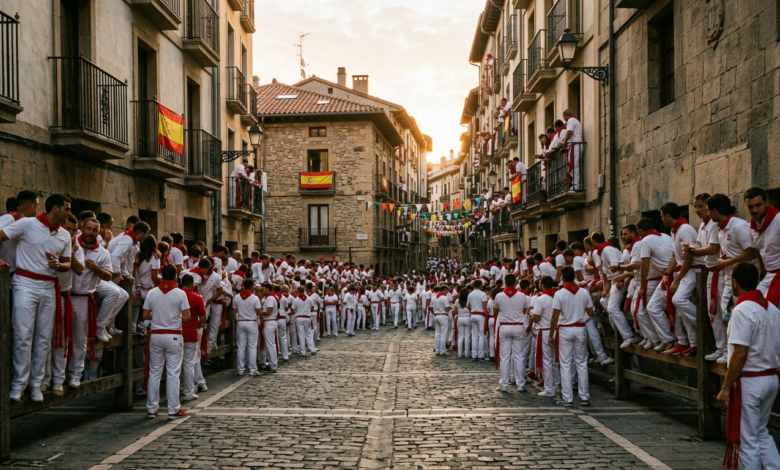
The novel’s centenary was marked on 6 July when this year’s festival opened with a firework blast over a packed plaza. The first of eight bull runs followed on 7 July, drawing tens of thousands of spectators and hundreds of runners through the same narrow streets Hemingway once described with such precision that readers felt they were already there.
“At noon of Sunday, the 6th of July, the fiesta exploded,” he wrote. “There is no other way to describe it.”
Americans still lead the charge
Hemingway’s influence on international attendance at San Fermin is measurable and lasting. Americans remain the largest group of foreign runners at the festival by a significant margin — accounting for 16% of all foreign participants in 2022, four times the number from neighbouring France, according to Pamplona’s City Hall.
Dallas-based tour operator Bruce Anderson has spent years bringing Americans to the festival. This year his company is bringing 1,400 people, more than two-thirds of them from the United States. Anderson, a lifelong Hemingway admirer with a thick white beard that local Spaniards sometimes mistake for the writer’s own likeness — greeting him with calls of “Papa!” — says the centenary has added a particular charge to the atmosphere.
“There’s a lot of energy, a lot of excitement around just remembering that book and the impact that it’s had,” he said, speaking from Pamplona’s art deco Cafe Iruña — a drinking spot featured prominently in the novel and now home to a life-size statue of Hemingway at the bar.
Hemingway’s presence is woven into almost every corner of the city. Hotels display busts of him. Bars carry plaques marking his visits. The Perla Hotel, where he stayed on his final trips to Pamplona, still keeps furniture from the 1950s in his suite, along with two glass bookcases filled with copies of The Sun Also Rises. A large banner hangs outside the bullring — itself home to a Hemingway statue — marking the novel’s centenary.
A legacy with complications
Not everyone in Pamplona celebrates Hemingway uncritically.
Animal rights groups have long targeted the San Fermin bullfights, and Hemingway’s enthusiastic celebration of bullfighting culture in the novel has made him a specific focus of that criticism. Activist Brook Spurling, speaking at a protest against the bullfights, argued that many of the themes Hemingway wrote about would not be considered acceptable today.
Some residents are more ambivalent still. The city of 200,000 welcomes over a million additional visitors during the nine-day festival, and the overtourism that Hemingway’s writing helped generate is a source of genuine frustration for locals who must live with its consequences year-round. One bar in Pamplona reportedly displays a sign reading “Hemingway was not here” — a small act of resistance against the literary franchise that has come to define the city.
Literature professor Gabriel Insausti of the University of Navarra put it plainly: “In general, Hemingway has become a product of a franchise associated with the San Fermin festival that has obscured his novel. People know who Hemingway is, but they haven’t read his book.”
What endures
Hillmann, who has since earned a doctorate in English and now teaches The Sun Also Rises at East-West University in Chicago, believes the novel’s power lies precisely in what it refuses to spell out. The running, the drinking, the impossible love affairs — they are symptoms of something deeper that Hemingway understood and that readers across a century have recognised in themselves.
Mariel Hemingway, the writer’s granddaughter, agrees. Speaking from her home in Idaho, she said the themes her grandfather explored — identity, love, purpose, and the struggle to rebuild after profound loss — remain as urgent now as they were in 1926.
“I think he captured something that will never go away,” she said.
A hundred years on, with the rockets still firing over Pamplona and the bulls still running through streets he made famous, it is difficult to argue with her.