Quick Comparison Table
| Event / Development | Date or Timeframe | Main Regions | Economic Impact | Geopolitical Impact | Status |
| Persian Gulf Naval Blockades & Energy Friction | Ongoing (August 2026) | Middle East, North America, East Asia, EU | Volatility in crude oil & LNG freight costs, transportation surcharges, sticky energy inflation | Heightened naval presence, risk of supply chain fragmentation, strained regional diplomacy | ONGOING |
| Federal Reserve & ECB Rate Convergence | September & November 2026 FOMC Meetings | North America, Eurozone, Emerging Markets | Higher cross-border borrowing costs, currency volatility, shifting foreign direct investment | Competing national monetary strategies, capital re-allocation between Western markets | CONFIRMED |
| U.S.–China Advanced Tech Export Restrictions | Ongoing / Q4 2026 Policy Deadline | United States, China, East Asia, EU | Supply chain realignment, semiconductor input shortages, corporate capex shifts | Strategic technological decoupling, regional security alliances, critical mineral controls | ONGOING |
| G20 Summit in Miami | December 14–15, 2026 | Global (G20 Economies) | Multilateral agreements on cross-border tax compliance, debt restructuring framework | Global governance alignment, North-South economic balancing, climate finance commitments | CONFIRMED |
| 81st UN General Assembly High-Level Week | September 15–22, 2026 | Global (New York, UN Headquarters) | Multi-year commitments to sustainable development funding and climate risk mitigation | Diplomatic negotiations on active conflicts, multilateral trade rules, international law | CONFIRMED |
| Red Sea & Suez Maritime Rerouting | Ongoing | Middle East, East Africa, Europe, Asia | Higher maritime insurance premiums, longer transit times, port congestion in Europe | Naval coalition commitments, strategic choke-point defense, shifting trade corridors | ONGOING |
As the world navigates the second half of 2026, the intersection of international diplomacy, monetary policy, and supply-chain security is defining the global outlook. Economic stability is no longer governed solely by market forces; it is increasingly shaped by statecraft, regulatory restrictions, and security conditions across major trade routes.
From energy frictions in the Middle East to calibrated technology controls between major industrial powers, developments unfolding in late 2026 carry cross-border consequences. For businesses, central banks, and sovereign investors, understanding how these geopolitical and macroeconomic events interact is essential for risk management and strategic planning.
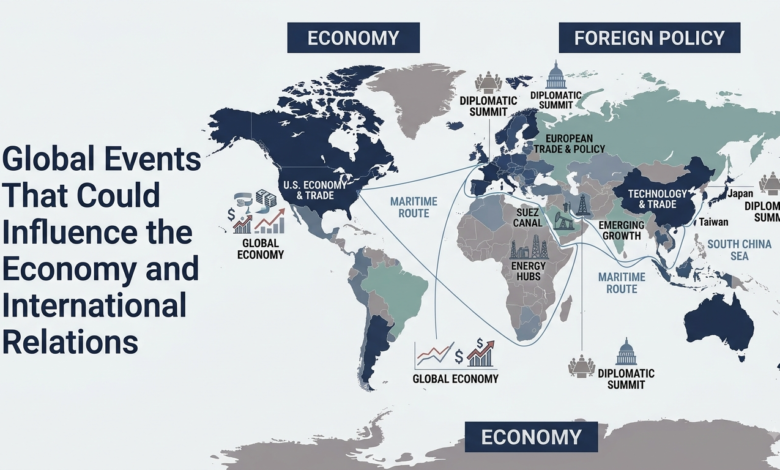
Global Events That Could Influence the Economy and International Relations
1. Persian Gulf Maritime Escalations and Energy Security
-
Status: ONGOING
-
Date or Timeframe: August 2026 onward
What Is Happening
Sustained naval blockades and commercial shipping escorts around the Strait of Hormuz continue to disrupt crude oil and liquefied natural gas (LNG) traffic. Diplomatic negotiations toward a permanent resolution remain slow, prompting extended naval deployments by international coalitions.
Why It Matters Economically
Because approximately 20% to 25% of the world’s petroleum passes through the Strait, maritime friction directly influences global energy benchmarks. Elevated crude prices ripple through industrial supply chains, increasing freight surcharges, agricultural fertilizer costs, and baseline inflation expectations across import-dependent economies.
Why It Matters Geopolitically
The situation tests regional security arrangements and international maritime laws. It forces energy-importing nations to diversify supply lines while managing complex diplomatic relations across the Middle East.
Countries/Regions Most Affected
Middle East, European Union, East Asia (Japan, South Korea, China), and North America.
What to Watch Next
-
Official statements following intermediate ceasefire talks mediated by regional partners.
-
Weekly crude oil inventory reports from the International Energy Agency (IEA) and the U.S. Energy Information Administration (EIA).
-
Surcharges announced by major ocean freight carriers navigating Persian Gulf routes.
Potential Scenarios
-
Base Case: Periodic maritime delays persist through Q4 2026, keeping Brent crude trading within a elevated, volatile range without total channel closure.
-
Upside Case: Diplomatic breakthroughs facilitate secured transit corridors, reducing maritime insurance premiums and easing energy costs.
-
Downside Case: Escalated military actions temporarily halt transit, pushing global energy prices sharply higher and reigniting central bank inflation concerns.
2. Central Bank Monetary Policy Divergence
-
Status: CONFIRMED
-
Date or Timeframe: Scheduled FOMC meetings (September 16–17, October 27–28, December 15–16, 2026)
What Is Happening
Major central banks—including the U.S. Federal Reserve, European Central Bank (ECB), Bank of England (BoE), and Bank of Japan (BoJ)—are entering distinct policy phases. While Western central banks balance elevated core inflation against moderating labor markets, the BoJ continues its gradual normalization away from historic ultra-loose policies.
Why It Matters Economically
Interest-rate differentials drive foreign exchange movements, cross-border capital flows, and sovereign debt servicing costs. Divergent rate strategies create currency fluctuations that impact import costs and export competitiveness worldwide.
Benchmark Rate Comparison (Mid-2026 Context)
-------------------------------------------------------------
Federal Reserve:     3.50% – 3.75% (Target Range)
European Central:    3.00% – 3.25% (Deposit Facility)
Bank of Japan:       0.50% – 0.75% (Policy Rate)
-------------------------------------------------------------
Why It Matters Geopolitically
Monetary policy impacts fiscal space for sovereign governments, influencing public investment in defense, green transition projects, and domestic infrastructure.
Countries/Regions Most Affected
United States, Eurozone, Japan, United Kingdom, and emerging market economies with dollar-denominated debt.
What to Watch Next
-
Policy statements and economic projections from the Federal Reserve’s September 2026 FOMC meeting.
-
Central bank balance sheet reduction rates (Quantitative Tightening) across the G7.
-
Capital flow data into emerging market sovereign bond markets.
Potential Scenarios
-
Base Case: The Fed holds benchmark rates near current levels through late 2026 to ensure inflation returns toward 2%, while European banks execute modest adjustments based on local growth.
-
Upside Case: Synchronized inflation declines allow global central banks to ease credit conditions, lowering global borrowing costs.
-
Downside Case: Resurgent energy inflation forces unexpected rate hikes, dampening global fixed-asset investment.
3. U.S.–China Advanced Technology and Supply-Chain Realignment
-
Status: ONGOING
-
Date or Timeframe: Second Half of 2026
What Is Happening
The technology competition between the United States and China continues to evolve, expanding beyond high-end semiconductors to encompass artificial intelligence models, critical mineral processing, and green-technology supply chains. Both nations are implementing updated export controls, outbound investment screening, and domestic industrial subsidies.
Why It Matters Economically
Multinational technology and manufacturing firms face rising compliance expenses and supply-chain fragmentation. Duplicate infrastructure spending in the U.S., Europe, and Asia increases production costs for consumer electronics, electric vehicles, and industrial machinery.
Why It Matters Geopolitically
Technology controls are closely tied to national security, defense readiness, and economic sovereignty. The policy landscape forces third-party nations—particularly in Southeast Asia, Europe, and Latin America—to navigate competing trade and security relationships.
Countries/Regions Most Affected
United States, China, Taiwan, South Korea, Japan, Netherlands, and ASEAN member states.
What to Watch Next
-
Updated regulatory releases from the U.S. Department of Commerce Bureau of Industry and Security (BIS).
-
Official Chinese trade statistics on rare earth element exports and critical mineral processing.
-
Quarterly capital expenditure guidance from major global semiconductor foundries.
Potential Scenarios
-
Base Case: Targeted restrictions on advanced technology persist while broader consumer electronics trade continues under heightened regulatory oversight.
-
Upside Case: Bilateral working groups establish clearer regulatory boundaries, lowering supply-chain uncertainty for commercial technology sectors.
-
Downside Case: Broadened export restrictions expand into essential legacy semiconductors, causing manufacturing bottlenecks across global automotive and industrial sectors.
4. G20 Summit in Miami and Multilateral Economic Governance
-
Status: CONFIRMED
-
Date or Timeframe: December 14–15, 2026
What Is Happening
The United States hosts the 2026 G20 Leaders’ Summit in Miami, bringing together heads of state from the world’s largest developed and developing economies. Key agenda items include international tax policy enforcement, sovereign debt relief frameworks for low-income nations, and global trade standards.
Major Global Summits Calendar (Late 2026)
-----------------------------------------------------------------------
81st UN General Assembly:   Sept 15–22, 2026 (New York, USA)
G20 Leaders' Summit:        Dec 14–15, 2026  (Miami, USA)
-----------------------------------------------------------------------
Why It Matters Economically
G20 consensus drives international regulatory frameworks, including cross-border digital taxation, climate finance allocations, and debt restructuring guidelines coordinated through the IMF and World Bank.
Why It Matters Geopolitically
The summit provides a high-level venue for bilateral diplomacy between global leaders, offering opportunities to manage trade friction and align on regional stability initiatives.
Countries/Regions Most Affected
G20 member nations, developing economies seeking debt restructuring, and international financial institutions.
What to Watch Next
-
Pre-summit Ministerial meetings on finance, trade, and energy occurring in October and November 2026.
-
Drafts of the final Leaders’ Declaration regarding trade fragmentation and debt stability.
-
Bilateral side-meetings scheduled between major economic powers.
Potential Scenarios
-
Base Case: G20 leaders sign a pragmatic communique committing to stable financial architecture and incremental progress on international debt frameworks.
-
Upside Case: Comprehensive agreement on multilateral debt restructuring accelerates capital access for emerging markets.
-
Downside Case: Geopolitical disagreements prevent a unified final joint statement, highlighting challenges in global economic coordination.
How Geopolitical Events Reach the Global Economy
Geopolitical developments affect global commerce through established economic channels. Understanding these linkages helps clarify how distant security or policy developments influence domestic financial conditions.
Transmission Mechanism Flowchart
--------------------------------------------------------------------------
Geopolitical Event (Conflict / Policy / Tariff)
       │
       ├──► Energy & Commodities (Supply shocks → Higher prices)
       │
       ├──► Trade & Logistics (Freight delays → Increased transit costs)
       │
       ├──► Financial Capital (Risk-off sentiment → Foreign exchange swings)
       │
       └──► Corporate Confidence (Uncertainty → Reduced long-term Capex)
--------------------------------------------------------------------------
-
Energy and Commodity Price Shock: Disruptions along key shipping corridors immediately affect crude oil, natural gas, and agricultural commodity prices, pushing baseline input costs higher for global manufacturers.
-
Trade and Logistics Surcharges: Rerouting commercial vessels around high-risk maritime zones increases transit duration, fuel consumption, and insurance rates, ultimately affecting consumer prices.
-
Financial Volatility and FX Realignment: International uncertainty prompts capital reallocation toward traditional safe-haven assets, altering exchange rates and raising borrowing costs for developing nations.
-
Corporate Capital Expenditure Postponement: Heightened policy ambiguity causes multinational corporations to delay long-term foreign direct investment (FDI) until regulatory conditions stabilize.
How These Events Could Reshape International Relations
The global political landscape in late 2026 reflects a shift toward strategic hedging and regional partnership building:
-
Minilateral and Regional Alliances: Nations are increasingly supplementing broad multilateral organizations with focused regional groupings (such as expanded economic partnerships in Asia-Pacific and Latin America) to secure critical trade links.
-
Energy Transition Diplomacy: The search for stable energy supplies is accelerating strategic partnerships between industrial consumers and resource-rich developing nations in Africa, South America, and Central Asia.
-
Sanctions Compliance and Enforcement: As economic sanctions remain a primary foreign policy tool, third-party countries face scrutiny over secondary compliance, leading to diplomatic negotiations regarding international financial messaging systems.
Trade Developments to Watch
International trade policy during the second half of 2026 is moving away from broad tariff reductions toward targeted industrial protection and supply-chain resilience:
Global Trade Policy Shift
-----------------------------------------------------------------
Traditional Framework       │  2026 Trade Architecture
• Broad tariff cuts          │  • Targeted industrial subsidies
• Offshoring efficiency      │  • Nearshoring & friendshoring
• Global supply integration  │  • Critical material export controls
-----------------------------------------------------------------
-
Critical Mineral Export Rules: Major producers of lithium, cobalt, nickel, and rare earth elements are enforcing strict domestic processing mandates to capture higher manufacturing value.
-
Nearshoring and Friendshoring Acceleration: Corporations continue relocating manufacturing capacity closer to end markets or into allied jurisdictions to hedge against geopolitical trade disruptions.
-
Digital Trade Governance: Rules governing cross-border data flows, cloud computing sovereignty, and artificial intelligence safety are becoming central components of regional trade agreements.
What Could Happen to Global Capital Flows?
Financial capital distribution across international markets is responding directly to geopolitical realignments and interest-rate differentials:
-
Sovereign Debt Re-evaluation: High global benchmark interest rates keep debt-servicing burdens elevated for emerging economies, prompting international investors to demand higher yield premiums.
-
U.S. Dollar Dynamics: Safe-haven demand and competitive yield structures keep the U.S. dollar resilient against peer currencies, impacting import purchasing power for dollar-denominated commodities worldwide.
-
Foreign Direct Investment (FDI) Divergence: Capital flows are increasingly directed toward nations offering political stability, reliable power grids, and preferential market access through established trade agreements.
Which Industries Are Most Exposed?
Geopolitical and macroeconomic developments affect individual commercial sectors in distinct ways:
-
Energy and Utilities: Directly exposed to maritime security conditions and regulatory policies governing traditional fossil fuels and renewable infrastructure spending.
-
Semiconductors and Consumer Technology: Vulnerable to technology export controls, critical mineral supply restrictions, and dual-sourcing requirements across competing trade zones.
-
Automotive and Transportation: Facing supply-chain costs related to tariff shifts, battery mineral origin requirements, and international freight route disruptions.
-
Commercial Agriculture and Fertilizer Manufacturing: Highly sensitive to natural gas input prices, ocean shipping stability, and regional weather volatility affecting global crop yields.
-
Aerospace and Defense: Experiencing increased order backlogs and public procurement support as governments worldwide expand national defense budgets.
Why Emerging Markets Could Be Especially Sensitive
Developing and emerging economies face heightened vulnerability to international economic and geopolitical shocks:
Emerging Market Vulnerability Factors
-----------------------------------------------------------------
External Pressure           │  Domestic Impact
• High U.S. Dollar Value    │  • Higher local currency import costs
• Elevated Interest Rates   │  • Increased external debt servicing
• Commodity Price Spikes    │  • Household food & energy inflation
-----------------------------------------------------------------
-
Import Inflation: Currency depreciation against the U.S. dollar increases local-currency costs for imported food, fuel, and capital machinery.
-
Debt Refinancing Constraints: Higher global interest rates limit borrowing options for low-income countries maturing sovereign bonds in late 2026, increasing reliance on IMF emergency lending facilities.
-
Resource Wealth Opportunities: Emerging markets rich in critical transition minerals (such as Chile, Indonesia, and Zambia) benefit from increased global investment, provided local regulatory frameworks remain stable.
Five Global Developments to Watch Most Closely
-
Persian Gulf Maritime Security and Crude Oil Transit: Any shift in shipping access through the Strait of Hormuz will immediately affect global energy prices and central bank inflation calculations.
-
Federal Reserve and Western Central Bank Interest Rate Guidance: Policy decisions at scheduled autumn FOMC meetings dictate global liquidity conditions, dollar strength, and borrowing costs.
-
U.S.–China High-Tech Regulatory Updates: Revisions to export control guidelines on artificial intelligence hardware and manufacturing equipment shape global tech supply chains.
-
December G20 Summit Outcomes in Miami: Agreement or divergence among world leaders on debt relief, international tax enforcement, and trade stability will set the 2027 global policy agenda.
-
Global Agricultural Yields and Supply Routes: Weather patterns and shipping costs in key grain-producing regions will determine food inflation trends across vulnerable populations.
Global Events Calendar: August–December 2026
The following confirmed calendar outlines major international summits, monetary policy meetings, and institutional releases scheduled for the remainder of 2026:
August 2026
-
August 21–23, 2026: Federal Reserve Bank of Kansas City hosts the annual Jackson Hole Economic Symposium (Jackson Hole, Wyoming, USA).
September 2026
-
September 15–22, 2026: 81st Session of the United Nations General Assembly (UNGA) High-Level Week (New York, USA).
-
September 16–17, 2026: U.S. Federal Reserve FOMC Interest Rate Decision and Economic Projections.
-
September 17, 2026: European Central Bank (ECB) Governing Council Monetary Policy Meeting.
October 2026
-
October 12–18, 2026: International Monetary Fund (IMF) and World Bank Group Annual Meetings (Washington, D.C., USA).
-
October 27–28, 2026: U.S. Federal Reserve FOMC Interest Rate Decision.
-
October 29, 2026: European Central Bank (ECB) Monetary Policy Meeting.
November 2026
-
November 3, 2026: United States Congressional Midterm Elections.
-
November 10–21, 2026: UN Climate Change Conference (COP31 negotiations).
December 2026
-
December 10, 2026: European Central Bank (ECB) Governing Council Monetary Policy Meeting.
-
December 14–15, 2026: G20 Leaders’ Summit (Miami, Florida, USA).
-
December 15–16, 2026: U.S. Federal Reserve FOMC Interest Rate Decision.
What We Know vs. What Could Change
Fast-moving international developments require distinguishing established facts from variable geopolitical scenarios:
Fact vs. Scenario Matrix
-----------------------------------------------------------------------------------------------------
Topic             │ Confirmed Fact                      │ Variable / Uncertain Scenario
------------------│-------------------------------------│--------------------------------------------
Central Bank Rates│ Target ranges set at current levels │ Speed & depth of 2027 monetary easing
G20 Summit        │ Scheduled for Dec 14–15 in Miami│ Consensus level on joint leaders' statement
Maritime Security │ Escort operations active in Gulf   │ Duration & diplomatic ceasefire timing
Tech Policy       │ Export control rules active         │ Scope of future mineral/chip restrictions
-----------------------------------------------------------------------------------------------------
The Biggest Cross-Border Risks for the Rest of 2026
An analysis of global economic stability highlights several primary cross-border risk categories:
-
Energy Market Supply Shock: Sustained geopolitical disruptions along key maritime choke points triggering renewed inflation waves.
-
Geoeconomic Fragmentation: Accelerated division of international trade into competing regulatory blocs, reducing global economic efficiency.
-
Fiscal Stress in Vulnerable Sovereign Nations: Prolonged high borrowing costs triggering debt restructurings in import-dependent developing countries.
-
Supply-Chain Concentration Vulnerabilities: Single-source reliance on critical technology inputs, processed minerals, or specialized manufacturing components.
Which Events Could Matter Beyond 2026?
Several developments unfolding in late 2026 will leave structural impressions on the global economy for years to come:
-
Redesigned Semiconductor and Battery Supply Chains: Multibillion-dollar industrial investments in North America, Europe, and Asia will permanently alter global tech manufacturing geography over the next decade.
-
Evolving Multilateral Financial Frameworks: Updates to sovereign debt restructuring mechanisms negotiated at the IMF, World Bank, and G20 will dictate how future financial crises are managed.
-
Energy Architecture Transformation: The dual push for domestic energy security and carbon reduction is permanently shifting long-term capital allocation away from single-source fuel dependencies.
FAQ
What global events could affect the world economy in 2026?
Major events include Persian Gulf maritime shipping security, Federal Reserve monetary policy decisions, U.S.–China technology trade regulations, international summit outcomes like the G20 in Miami, and weather impacts on global food production.
Which geopolitical risks should businesses watch?
Businesses should closely monitor trade policy changes, maritime supply-chain security along global choke points, export controls on critical minerals and technology, and currency volatility driven by interest rate differentials.
How can wars affect energy prices and inflation?
Conflicts in key production or transit regions disrupt supply flows, driving up crude oil and natural gas prices. Higher energy costs increase transportation, manufacturing, and heating expenses, feeding directly into broader consumer inflation.
How could U.S.–China relations affect global trade?
Updated export controls, technology investment restrictions, and tariff policies encourage corporations to diversify supply chains into third-party nations, increasing compliance costs and restructuring industrial logistics.
Which central-bank decisions matter most for global markets?
Policy decisions by the U.S. Federal Reserve, European Central Bank, Bank of Japan, and Bank of England set international benchmark interest rates, influencing currency exchange rates, capital flows, and global borrowing costs.
What international events are still scheduled for 2026?
Confirmed events include the 81st UN General Assembly High-Level Week in September, IMF/World Bank Annual Meetings in October, COP31 climate negotiations in November, and the G20 Leaders’ Summit in Miami in December.
Which global risks could have the biggest economic impact?
A major supply disruption along critical energy transit routes or a sudden sharp escalation in trade restrictions between leading industrial economies represent the highest-impact economic risks.
How can businesses prepare for geopolitical uncertainty?
Companies prepare by diversifying supply-chain sources, dual-sourcing critical components, hedging foreign exchange and energy price risks, and maintaining strict regulatory compliance frameworks.
The remainder of 2026 presents a complex international environment where economic performance is intertwined with geopolitical statecraft. As central banks navigate inflation risks and governments adjust trade and energy strategies, stability will depend on clear diplomatic communication and resilient commercial practices. By tracking confirmed policy changes and understanding global economic transmission channels, decision-makers can navigate the uncertainties shaping international relations and markets.