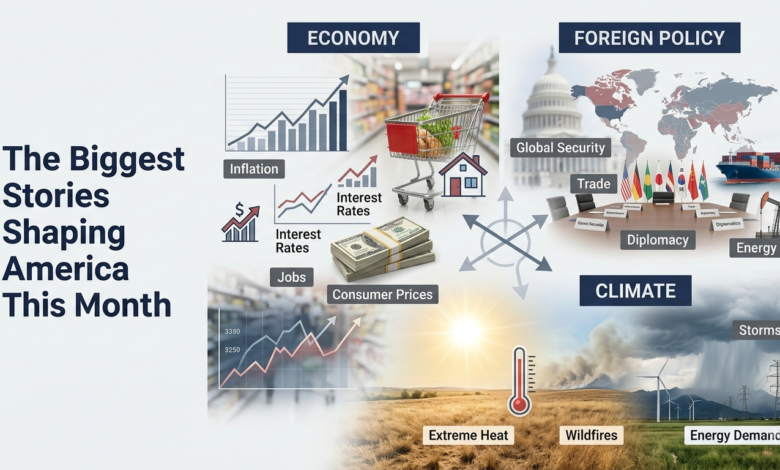
Quick News Table of Biggest Stories Shaping America
| Rank | Story | Category | Why It Matters | Status |
| 1 | U.S.-Iran Maritime Conflict & Strait Closure | Foreign Policy / Energy | Disrupts global oil transit, drives gasoline price volatility, and increases naval escort costs | Ongoing |
| 2 | Federal Reserve Rate Policy & Sticky Inflation | Economy / Finance | Benchmark interest rates held at 3.50%–3.75% amid split labor-market and inflation signals | Awaiting Decision |
| 3 | Persistent Cost-of-Living Pressures | Economy / Society | Grocery bills, housing costs, and energy prices remain top voter concerns before the midterms | Ongoing |
| 4 | Record-Breaking Heat Wave Across Lower 48 | Climate / Infrastructure | Following the hottest July on record, August heat strains power grids and public health systems | Developing |
| 5 | August Congressional Midterm Primaries | Politics / Elections | Key state primary results set final candidate matchups for House and Senate control in November | Confirmed |
| 6 | Border Policy & Citizenship Verification Debates | Immigration / Policy | Federal agency operations and state-level voter roll rules prompt legal and administrative battles | Under Investigation |
August 2026 is proving to be an unusually consequential month for the United States, defined by intersecting pressures across foreign policy, macroeconomics, climate conditions, and domestic politics. International maritime conflicts in the Middle East continue to ripple directly into domestic energy markets, while the Federal Reserve navigates conflicting signals between moderating labor growth and elevated consumer prices.
Simultaneously, record-setting summer temperatures across the contiguous U.S. are testing regional energy grids, and a decisive wave of late-summer congressional primaries is locking in candidate matchups for the November 2026 midterm elections. This monthly briefing provides a factual, evidence-driven analysis of the major stories shaping American life as August unfolds.
The Biggest Stories Shaping America This Month
1. U.S.-Iran Maritime Escalation and Energy Market Volatility
What Happened
Following months of military friction, naval operations in and around the Strait of Hormuz continue to disrupt commercial shipping traffic. In mid-August, U.S. officials indicated that naval blockade and escort operations aimed at securing international sea lanes could continue indefinitely as diplomatic efforts toward a permanent ceasefire remain stalled.
Why It Matters
Approximately 20% to 25% of global seaborne petroleum and liquefied natural gas (LNG) passes through the Strait. Sustained maritime friction keeps crude oil prices elevated, directly driving up U.S. retail gasoline prices and heating costs for transportation networks.
Strait of Hormuz Disruption Overview
------------------------------------------------------------
Global Oil Trade Transit:   ~25% Normally Transited
U.S. Operational Posture:   Active Blockade / Escorts
Primary Domestic Effect:    Transportation & Energy Price Inflation
------------------------------------------------------------
Who Is Affected
American commuters, freight carriers, airline operators, energy companies, and consumer goods distributors face higher fuel surcharges.
What Happens Next
Markets are closely monitoring upcoming diplomatic talks convened through regional intermediaries to assess whether limited maritime transit agreements can be reached before autumn energy demand rises.
-
Current Status: Ongoing
2. Federal Reserve Policy and Mixed Economic Signals
What Happened
At its late-summer policy review, the Federal Reserve maintained the benchmark federal funds rate at 3.50%–3.75%. An August 12–17 Reuters poll of economists showed a 90% consensus that the central bank will likely hold rates steady through the end of 2026, despite dissenting votes within the Federal Open Market Committee (FOMC) favoring rate increases to combat persistent energy-driven inflation.
Why It Matters
High borrowing costs continue to restrict mortgage availability and small business lending. However, with July employment data showing softer job growth alongside consumer price index (CPI) annual inflation lingering near 3.4%, central bankers face a delicate balance between preventing economic deceleration and stabilizing prices.
Who Is Affected
Homebuyers, current mortgage holders seeking to refinance, credit card users, and business executives planning capital expenditures.
What Happens Next
Economists and financial markets are awaiting Fed Chair communications at the annual Jackson Hole Economic Symposium later in August for guidance on autumn rate policy.
-
Current Status: Awaiting Decision
3. Food Prices and Household Cost-of-Living Pressures
What Happened
Data from the U.S. Bureau of Labor Statistics (BLS) indicates that while overall headline inflation has moderated from multi-year peaks, grocery and staple food prices remain elevated relative to pre-2024 baselines. August market surveys show continued voter focus on essential daily expenditures.
Why It Matters
Food and housing costs absorb a disproportionate share of lower- and middle-income household budgets. Persistent cost-of-living concerns directly inform consumer sentiment and serve as the central topic in economic debates leading into the 2026 midterms.
Who Is Affected
Lower- and middle-income families, retirees on fixed incomes, and retail grocers adjusting to shifting consumer purchasing habits.
What Happens Next
The release of the August Consumer Price Index report in mid-September will confirm whether late-summer energy price increases translated into higher food processing and logistics costs.
-
Current Status: Ongoing
4. Historic Heat Wave Tests National Infrastructure
What Happened
Following news from the National Oceanic and Atmospheric Administration (NOAA) that July 2026 was the hottest month on record for the contiguous United States—averaging 76.89°F and surpassing Dust Bowl-era records from 1936—extreme summer heat has extended into August across the Southwest, Midwest, and Atlantic regions.
Contiguous U.S. July Average Temperatures (NOAA Data)
-----------------------------------------------------
1936 (Dust Bowl Peak): 76.77°F
2026 (New Record):     76.89°F
Primary Driver:        Record-High Nighttime Low Temperatures
Why It Matters
Unusually high nighttime minimum temperatures prevent structural cooling, leading to record electricity demand, elevated water consumption, agricultural stress, and heightened public health risks for outdoor workers and vulnerable populations.
Who Is Affected
Power utility operators, agricultural producers, municipal health departments, construction crews, and residents in urban heat islands.
What Happens Next
Regional grid managers (such as ERCOT and PJM Interconnection) are issuing capacity warnings and encouraging voluntary conservation during late-afternoon demand peaks throughout August.
-
Current Status: Developing
5. Key August Primaries Lock in 2026 Midterm Matchups
What Happened
Throughout August, voters across multiple states—including South Carolina, Wisconsin, Alaska, and Wyoming—are casting ballots in key primary elections to nominate candidates for the U.S. House, U.S. Senate, and state governorships ahead of the November 3, 2026 general election.
Why It Matters
Primary outcomes determine the ideological direction of both major political parties. Competitive primaries in swing districts test whether voters favor moderate platforms or aligned party bases, establishing campaign messaging strategies for the fall.
Who Is Affected
Political parties, congressional candidates, campaign donors, and voters preparing for the general election.
What Happens Next
State election officials will certify primary results, initiating the official post-Labor Day general election campaign phase.
-
Current Status: Confirmed
6. Debates Over Voting Access and Citizenship Verification
What Happened
State legislatures and federal courts in August are handling active litigation regarding voting administration, voter identification mandates, and proof-of-citizenship requirements for voter registration rolls ahead of the midterms.
Why It Matters
Proponents argue stricter voter registration procedures enhance election integrity and public confidence. Opponents contend that aggressive documentation mandates create administrative hurdles for legal voters, low-income citizens, and college students.
Who Is Affected
Local election administrators, civic voter-registration organizations, and legal-age voters navigating state-specific ID rules.
What Happens Next
Federal district courts are scheduled to issue preliminary rulings on several state voter-roll challenges before pre-election administrative cutoffs in September.
-
Current Status: Under Investigation
How These Stories Could Affect Everyday Life
The combined impact of these major developments directly influences household economics and routines:
-
At the Gas Pump: Maritime tensions in the Persian Gulf keep domestic fuel prices sensitive to international supply news.
-
At the Grocery Store: Food transportation surcharges and heat-related crop impacts maintain price floors on dairy, meat, and fresh produce.
-
Utility Bills: Extended air conditioning use during August heat waves leads to higher monthly residential electric bills.
-
Mortgages & Credit: With the Fed holding benchmark interest rates around 3.50%–3.75%, home mortgage rates remain elevated, maintaining housing affordability constraints.
How August’s Biggest Stories Could Shape U.S. Politics
August news trends set the baseline political environment for the final sprint to the November 3, 2026 congressional midterms:
-
Incumbent Dynamics: High energy prices and persistent living costs provide political arguments for challenger candidates targeting incumbent congressional seats.
-
Congressional Strategy: Democrats are emphasizing consumer protection, lowering drug prices, and clean-energy investments, while Republicans focus on border enforcement, federal spending cuts, and deregulation.
-
Suburban Voter Mobilization: Swing voters in competitive suburban districts are showing high sensitivity to interest rate trends, local school funding, and healthcare affordability.
What These Stories Mean for the U.S. Economy
The U.S. macroeconomic outlook in late August reflects competing forces:
Economic Cross-Currents (August 2026)
-----------------------------------------------------------------
Growth Indicators           │  Cost & Inflation Pressures
• Stable corporate earnings │  • Energy market volatility
• Solid productivity output │  • High mortgage borrowing rates
• Steady low unemployment   │  • Persistent food price floors
-----------------------------------------------------------------
-
Inflation vs. Growth: While supply-chain improvements have stabilized many manufactured goods, service-sector and energy costs prevent inflation from rapidly cooling to the Fed’s 2.0% target.
-
Labor Market Cooling: Moderating job-growth numbers suggest the labor market is normalizing, reducing the risk of wage-driven inflation while raising awareness around employment stability.
Five Developments That Could Change the News Cycle
As August progresses, five potential developments could rapidly alter national headlines:
-
Diplomatic Movements in Middle East Shipping: Any breakthrough or sudden escalation in the Strait of Hormuz will immediately impact oil futures.
-
Federal Reserve Jackson Hole Addresses: Statements by central bankers could reshape market expectations for autumn interest rate policy.
-
Late-Summer Tropical Weather Formations: Tropical storms developing in the Atlantic could threaten Gulf Coast refining infrastructure.
-
Federal Appeals Court Election Rulings: Key decisions regarding state redistricting or voter documentation could alter the election playing field.
-
Pre-Labor Day Economic Releases: Revisions to corporate earnings and revised GDP estimates will offer clearer signals on third-quarter momentum.
Important Dates Still Ahead This Month
The following confirmed schedule covers key national events for the remainder of August 2026:
-
August 18, 2026: Primary elections held in Alaska and Wyoming.
-
August 20, 2026: U.S. Department of Labor weekly initial unemployment claims release.
-
August 21–23, 2026: Federal Reserve Bank of Kansas City hosts the annual Jackson Hole Economic Symposium.
-
August 26, 2026: U.S. Census Bureau releases monthly New Residential Sales data for July.
-
August 28, 2026: Bureau of Economic Analysis (BEA) releases July Personal Income and Outlays report (including PCE Price Index).
What We Know vs. What Remains Uncertain
Fast-moving national news cycles require distinguishing confirmed facts from ongoing projections:
Fact vs. Uncertainty Matrix
---------------------------------------------------------------------------------------------
Category          │ Confirmed Fact                    │ Remaining Uncertainty
------------------│-----------------------------------│--------------------------------------
Fed Rate Policy   │ Rate held at 3.50%–3.75% in July  │ Timing of future rate adjustments
Middle East Energy│ Shipping disruptions present      │ Duration of naval operations
Climate Conditions│ July 2026 contiguous U.S. record  │ Total seasonal crop/grid impact
---------------------------------------------------------------------------------------------
How to Evaluate Fast-Moving U.S. News
To maintain information quality during major news cycles, consider these media-literacy practices:
-
Check the Publication Timestamp: Confirm that reporting reflects current August 2026 developments rather than archived context.
-
Verify Primary Sources: Look for direct citations from primary institutions such as the U.S. Bureau of Labor Statistics, NOAA, or federal court dockets.
-
Cross-Reference Breaking Claims: Wait for independent verification from established news outlets before accepting social media claims regarding foreign military actions or political events.
-
Identify Synthetic Media: Be aware of AI-generated audio or video content circulating during election seasons, verifying imagery against official press pools.
FAQ
What are the biggest U.S. stories this month?
The top stories in August 2026 include Middle East shipping disruptions in the Strait of Hormuz, Federal Reserve interest rate policy decisions, record-breaking summer heat conditions across the continental U.S., and final primary elections leading into the 2026 midterms.
What is happening with the U.S. economy in August 2026?
The U.S. economy is showing a mix of moderating job growth, steady productivity, and elevated consumer borrowing costs. Benchmark interest rates remain at 3.50%–3.75% while inflation sits near 3.4%.
How is the Iran conflict affecting the U.S.?
Naval blockades and shipping restrictions near the Strait of Hormuz have restricted regional oil transit, creating global energy market volatility and keeping U.S. gasoline prices elevated.
What is happening with U.S. interest rates?
The Federal Reserve kept interest rates unchanged at 3.50%–3.75% at its late-summer meeting. A consensus of economists expects rates to stay on hold through the end of 2026 unless inflation decelerates faster than projected.
What are the biggest political stories in August 2026?
Key political stories include August congressional primaries finalizing House and Senate slates, debates over state-level voter registration verification, and party campaign framing on cost-of-living issues.
What major events are still expected this month?
Upcoming key events include the Jackson Hole Economic Symposium, state primaries in Alaska and Wyoming, and official July PCE inflation data from the Bureau of Economic Analysis.
How is extreme weather affecting the United States?
Following record July temperatures across the contiguous U.S., August heat is placing sustained demand on power grids, agriculture, and public health systems.
Where can readers find reliable U.S. news updates?
Reliable news updates can be accessed directly through primary government agencies (e.g., BLS, NOAA, Federal Reserve) and nonpartisan wire services including Reuters and the Associated Press.
August 2026 highlights how global security, economic policy, climate patterns, and domestic politics interact. As energy markets adjust to international shipping developments and household budgets adapt to current interest rates, these headlines provide the context for the upcoming 2026 midterm elections. Tracking official data releases and confirmed news reporting will remain essential for readers navigating the rest of the month.