SK Hynix Launches $28 Billion US Listing — and Opens the AI Memory Trade to American Investors

South Korean chipmaker SK Hynix is set to become significantly more accessible to US investors this week, launching a $28 billion Nasdaq listing that ranks among the largest share sales ever attempted and signals just how central memory chips have become to the global artificial intelligence buildout.
The company will sell 17.79 million new shares in the form of American Depositary Receipts, with ten ADRs representing one common share. Pricing is expected Thursday, with trading beginning Friday. Management will meet institutional investors on a roadshow throughout the week.
If completed at the expected size, the deal would be the second-largest share sale on record, trailing only last month’s $85.7 billion SpaceX IPO and surpassing Saudi Aramco’s $25.6 billion offering in 2019 and Alibaba’s similarly-sized listing that same year.
Why this listing matters beyond the headline number
For most of SK Hynix’s rise — and it has been a remarkable one, with shares up roughly 273% this year on the Seoul exchange — US institutional investors had no straightforward way to own the stock. The Nasdaq listing changes that directly.
“SK Hynix has been one of the most important companies in the world that most US institutions could not easily own,” said Dave Mazza, chief executive of Roundhill Investments, which manages an ETF tracking DRAM manufacturers and has become one of the most popular US vehicles for gaining exposure to SK Hynix. “The listing removes an accessibility discount, not a quality discount.”
Steve Sosnick, chief strategist at Interactive Brokers, added that the listing would particularly benefit individual investors and smaller institutions who currently lack practical routes into the stock. “The new listing will make it easier for capital-hungry Hynix to directly access a new group of momentum-hungry investors,” he said.
Analysts expect SK Hynix to join the Philadelphia SE Semiconductor Index following the listing, a move that would trigger a wave of passive investment flows and help close the valuation gap with US rival Micron. HSBC last month raised its valuation on the company, applying a 20% premium to its previous price-to-book multiple, citing improved accessibility to global investors and more shareholder-friendly capital allocation.
The AI memory boom driving the deal
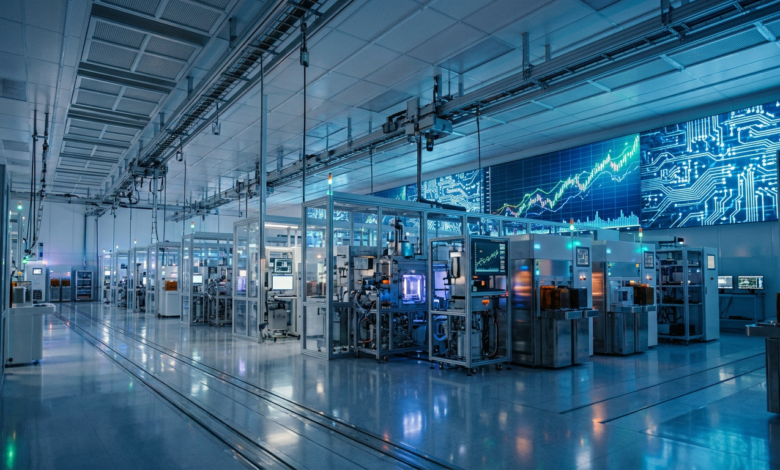
SK Hynix sits at the centre of one of the most consequential supply chains in technology. The company is the dominant supplier of high-bandwidth memory chips — the specialised components that sit alongside AI processors in data centre systems — with Nvidia and Google among its largest customers. As demand for AI computing infrastructure has accelerated, SK Hynix has outpaced rivals Samsung and Micron in capturing that growth.
Proceeds from the listing will fund new chip factories in South Korea and the purchase of advanced manufacturing equipment, including extreme ultraviolet lithography machines from Dutch equipment maker ASML — the tools required to produce the next generation of memory at scale.
The listing arrives against a broader national push. South Korea last week unveiled a sweeping semiconductor and AI industrial strategy anchored by a $576 billion chip investment programme. SK Hynix and Samsung will anchor that initiative, and President Lee Jae Myung has ordered officials to accelerate approvals for major chip and AI projects, warning that delays in permits, land acquisition, and power supply could cost the country its position in advanced manufacturing.
The caution behind the confidence
Not every signal is uniformly positive. SK Hynix shares fell around 4% in Seoul on Monday, and memory chip stocks have been volatile in recent sessions as investors weigh how long the AI-driven demand cycle can sustain current pricing levels.
Some analysts warn that rising memory costs — what one observer called memory “inflation” — could eventually weigh on spending across AI infrastructure, mobile, and PC markets.
“We expect better access, but timing of the memory cycle is equally important,” said Sundeep Gantori, chief investment officer of equities at Standard Chartered. “We believe the memory cycle is beyond the early phase and now in the mid-cycle stage.”
Albert Yong, managing partner at Petra Capital Management, struck a more confident note. “While market volatility has been quite high recently, I would expect demand for SK Hynix shares to remain relatively robust,” he said.
The final pricing on Thursday will test that confidence directly — and give the clearest market signal yet of how much US investors are willing to pay for a direct stake in the AI memory trade.