Hope and Urgency as Congo Launches Landmark Ebola Treatment Trial Amid Growing Outbreak

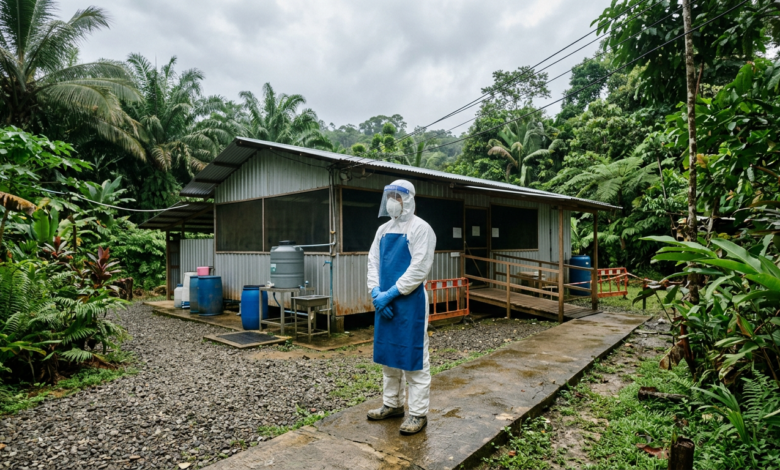
Researchers have begun a long-awaited clinical trial testing potential treatments for the Bundibugyo strain of Ebola in eastern Congo, offering a rare moment of cautious optimism to communities that have watched the outbreak claim hundreds of lives over recent weeks.
The trial launched quietly at the Evangelical Medical Center in Bunia, the capital of Ituri province, in early July — with ambulances still arriving and healthcare workers moving in and out of isolation wards as the first participant was enrolled. There was no ceremony. The urgency of the situation left little room for one.
The World Health Organization confirmed the trial’s launch on Thursday, the same day its director-general reported that more than 1,400 people had been diagnosed with the disease and at least 438 had died.
What the trial is testing and how it works
The Bundibugyo virus, which is causing the current outbreak, is one of the rarer strains responsible for Ebola disease. Unlike the more commonly known Zaire strain, it has no approved treatments or vaccines, leaving clinicians with few options beyond supportive care.
The trial will evaluate three approaches: the antiviral drug remdesivir, the experimental antibody treatment MBP134, and a combination of both. Survival will be tracked across a 28-day window following the start of treatment, according to WHO research adviser Dr. Vasee Moorthy.
The study is a collaboration between Congo’s national biomedical research institute INRB, Oxford University in Britain, Antwerp’s Institute of Tropical Medicine, and several other international health organisations. Professor Placide Mbala, who coordinates laboratory activities for the outbreak response, said the research could run for between three and six months depending on how quickly the outbreak evolves.
A second phase of the trial, currently in planning, will extend to healthcare workers, close contacts, and others at elevated risk of infection — not just confirmed patients inside treatment centres.
What residents are saying
For many people in Bunia, the trial represents the first concrete reason for hope after weeks of deteriorating news.
Audrey Tengetenge, a local resident, described the development as a light at the end of the tunnel, expressing hope that results would come quickly and bring relief to a community living in sustained fear.
Gladys Munguro, an Ebola survivor discharged from a treatment centre two weeks ago, said she watched fellow patients die while receiving care. Now recovered, she said she intends to volunteer when the second phase of the trial opens to high-risk individuals.
Not everyone shares that confidence. Nelson Dhebi, a shopkeeper in Bunia, said he supports scientific research in principle but worries about the risks involved and believes elected officials should be among the first to participate — a sentiment that reflects broader community wariness about the process.
The obstacles researchers still face
Community mistrust is one of several significant challenges slowing the outbreak response. Healthcare workers in Ituri have faced violence while trying to reach patients in conflict-affected areas. Overcrowded treatment centres, delays in people coming forward for care, and restricted access to insecure zones have all compounded the difficulty of containing the virus.
The scale of deaths occurring outside clinical settings underscores just how far the outbreak has outpaced the formal response. Congo’s National Institute of Public Health reported that nearly three in four Ebola deaths during this outbreak have occurred outside health facilities — a figure that points to the barriers preventing people from reaching care in time.
For now, the trial is running exclusively at the Evangelical Medical Center in Bunia. Officials have said they intend to expand it to additional sites once security conditions allow.
The coming weeks will determine whether the treatments being tested can shift the odds for patients currently facing a disease with no proven cure — and whether the trial can maintain the community trust it will need to reach the scale required to produce meaningful results.