The 2026 FIFA World Cup produced one of its most extraordinary moments off the pitch on Sunday — not through a goal or a tactical masterstroke, but through a phone call that reached from the White House to the top of world football.
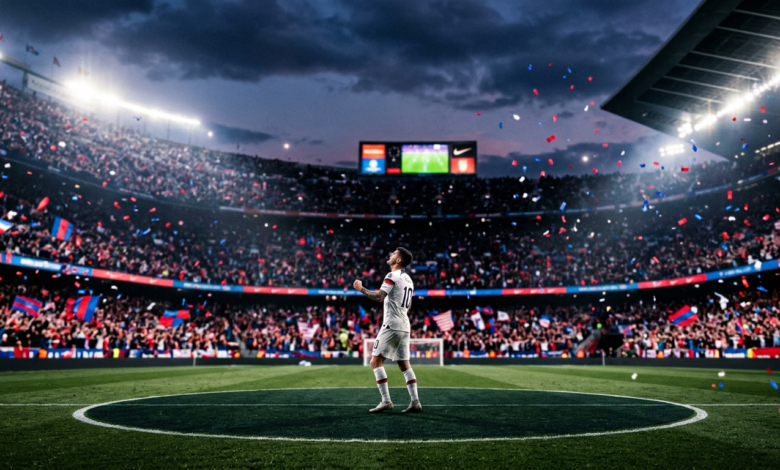
Folarin Balogun, the United States striker who scored his third goal of the tournament in a 2-0 win over Bosnia and Herzegovina before being sent off in the same match, will be available to face Belgium in Monday’s last-16 tie in Seattle. FIFA confirmed Sunday that it had suspended the automatic one-match ban that followed his red card, citing Article 27 of its Disciplinary Code — a provision that grants its judicial body discretion to place a sanction on probation rather than enforce it immediately.
The decision came after US President Donald Trump contacted FIFA President Gianni Infantino to request a review of the sending-off, according to a source briefed on the conversation. FIFA did not respond to questions about the call.
The reaction was instant and fierce.
What FIFA actually decided — and why Belgium says it breaks the rules
FIFA’s statement was precise but narrow. The organisation did not overturn or rescind the red card. Instead, it placed the resulting suspension into a probationary period of one year under Article 27 of its Disciplinary Code. Should Balogun commit another infringement of similar gravity during that period, the original ban would be enforced alongside any additional punishment.
The Royal Belgian Football Association pushed back immediately, arguing the decision contradicts two separate provisions of FIFA’s own rulebook. Article 66.4 of the Disciplinary Code states that a red card automatically results in a suspension for the team’s next match — a rule applied consistently throughout this tournament. Article 10.5 of the World Cup Regulations reinforces it, stating that any player sent off will automatically miss their team’s subsequent fixture.
Belgium said it was “astonished” by the ruling and confirmed it was investigating all available options, stopping short of announcing a formal protest or appeal.
The tension between Article 27’s discretionary powers and the automatic suspension provisions in Articles 66.4 and 10.5 is now at the centre of a legal and reputational debate that will outlast Monday’s match regardless of the result.
Trump celebrated. Balogun’s teammates found out on their phones.
Trump posted on Truth Social that he was grateful to FIFA for “reversing a great injustice.” The White House followed with a post on X reading “USA-USA-USA.” The US Soccer Federation accepted the decision without public comment on the circumstances surrounding it.
The players themselves were among the last to know. Christian Pulisic, speaking to reporters at the team’s Seattle training session, said the squad learned the news on their phones during the journey over.
“At first, you’re like, is this real?” Pulisic said. “And then — this is great news.”
US coach Mauricio Pochettino, who had argued publicly after the match that the red card was undeserved, welcomed the reversal. He pointed out that suspending sanctions under Article 27 was not without precedent, noting that Cristiano Ronaldo had benefited from a similar provision — FIFA suspended the final two matches of a three-game ban he carried into last year’s World Cup qualifying campaign, clearing him to play Portugal’s opening group fixtures.
The comparison has limits. Ronaldo’s case involved a ban carried over from qualifying, not an automatic suspension triggered by a red card during the tournament itself. Qatar midfielder Assim Madibo, sent off for a challenge that seriously injured Canada’s Ismael Kone earlier in the group stage, received a five-match ban with no equivalent leniency.
The broader question football now has to answer
Beyond the specific disciplinary arguments, the episode has raised a question that no rulebook provision can easily resolve: what happens when political pressure and sporting governance collide in public, at the world’s most-watched sporting event?
FIFA’s silence on the Trump-Infantino call has deepened rather than dampened the controversy. With Belgium’s legal options still open and Monday’s match now carrying an asterisk before a ball has been kicked, the debate over where FIFA’s authority begins and ends is unlikely to be settled at the final whistle.